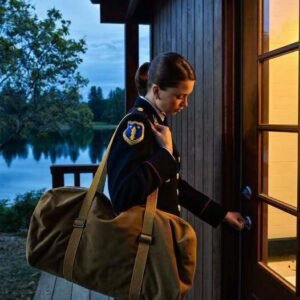
My grandfather passed away with full military honors.
My parents received his estate and fortune, while I was left with nothing but a single envelope—and my father’s dismissive, icy laugh.
That is, until I arrived in London on a one-way ticket, stepped out into the rain outside Heathrow, and saw a uniformed driver holding a sign with my name on it—like my grandfather had arranged one final assignment for me, one my family never expected or even saw coming.
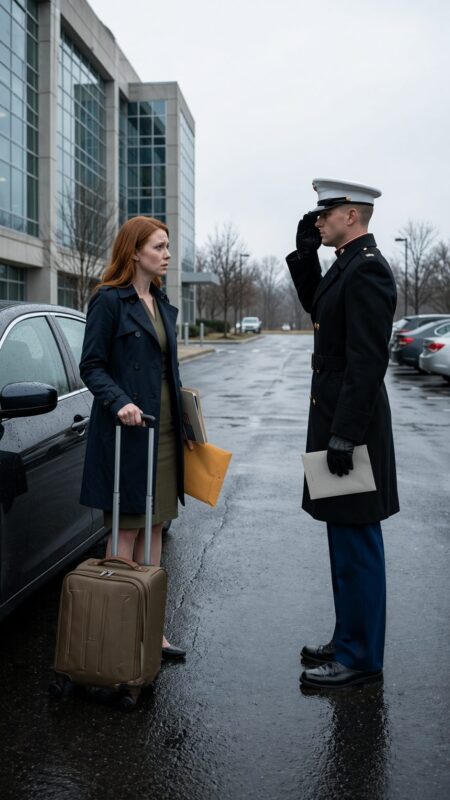
The twenty-one-gun salute rolled across the Virginia hills, its final echoes dissolving into a heavy, deliberate silence.
Through the tall windows of the Carter estate library, I watched as Marines folded the flag with flawless precision, each movement exact, rehearsed, final.
“Your name,” Mr. Halloway called, drawing me back inside.
The house had never felt like a home. It was something else—an archive of expectations, long corridors lined with history, every room shaped by legacy rather than comfort.
At the center of it all had always been my grandfather, General Theodore Carter. A man defined by discipline and quiet authority, admired by many, feared by just as many.
The last time I saw him, he spoke about work no one could see—and looked at me as if I was supposed to understand something he never said out loud.
That look stayed with me. Now, he was gone.
Grief in the room was controlled, almost organized. My grandmother held the folded flag with steady hands.
My mother was already calculating what would change. My brother seemed detached, uninterested. My father—he looked ahead, as if the future had already opened for him.
When the estate was announced, everything passed to my parents. My father didn’t celebrate, but his satisfaction was unmistakable.
Then my name was called again. Not for wealth. For an envelope.
Inside: a one-way ticket to London. And a note, written in my grandfather’s hand: Report to London. Duty does not end when the uniform comes off.
No explanation. No comfort. Just an order. I left the next morning.
At Heathrow, a representative from the Royal Household was waiting. Within hours, I was standing inside Buckingham Palace, hearing the truth my grandfather had never spoken aloud.
He had once been part of a classified Anglo-American operation. And long after the missions ended, he built something in silence—a foundation for veterans, sustained quietly for decades.
But as his health declined, that foundation had been mishandled. Controlled by people who saw it not as responsibility—but as access.
People in my own family. He hadn’t left me money. He had left me a task: fix it.
In London, I took control—piece by piece. Records, accounts, oversight. Everything was examined, corrected, restored.
When I returned home, I didn’t argue. I didn’t accuse. I brought evidence. Documents. Facts that spoke louder than anything I could say.
The foundation was reinstated under proper authority. Misused funds were frozen. Structures shifted.
And everything my family thought they owned began to fall apart—not through confrontation, but through exposure.
My father resisted at first. Denial came easily. But systems don’t bend to denial. One by one, his control disappeared. Influence faded.
Eventually, there was nothing left to argue against. Only silence.
Months later, the foundation was formally relaunched in Washington.
For the first time, I spoke publicly—not about inheritance, but about responsibility. About what we carry forward, not what we receive.
Afterward, my father approached me. His apology came late—too late to change what had happened—but it was real enough to acknowledge the truth between us.
Back at the estate, he offered to help rebuild.
I didn’t refuse.
But I made one thing clear: this was no longer about authority. It was about service.
Later, I stood at my grandfather’s grave, turning the silver chess queen he had once given me between my fingers.
Only then did I fully understand. He hadn’t left me property.
He had left me purpose. And this time, I followed it all the way.