We had always believed our mother had become wealthy — maybe even a millionaire — thanks to all the money we kept sending her.
But when we finally came back to the Philippines, we weren’t greeted by comfort or success… only a fragile shanty hut — and a hidden truth waiting to be uncovered.
I’ll never forget the crushing heat of that afternoon—it felt like a silent accusation, reminding me how long I had stayed away.
For years, I convinced myself that regular video calls and steady money transfers were enough to prove I was a good son.
My name is Rafa. I’m thirty-five, an engineer based in Dubai, where everything runs on structure, timing, and exact numbers.
But no amount of logic or planning could have prepared me for what we were about to face.
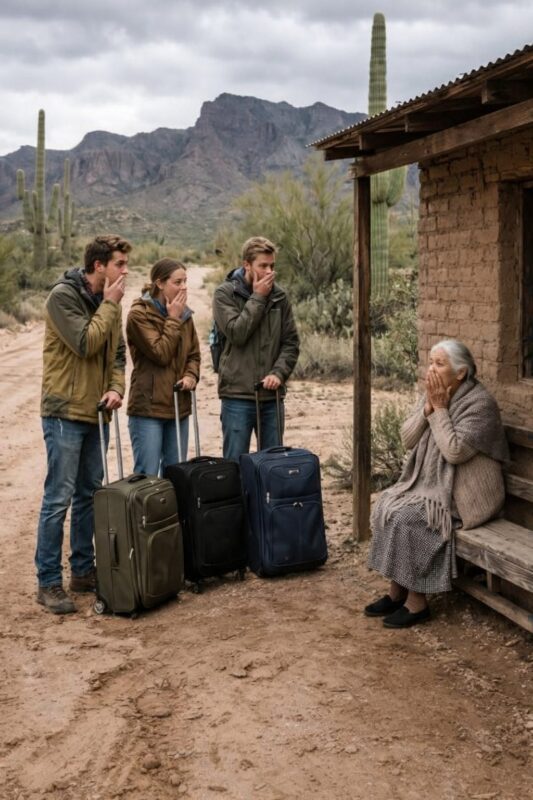
I flew back home with my sister Mela and my younger brother Miggy, all of us eager to surprise our mother.
For five years straight, we had sent her money every month—altogether, more than three million pesos. In our minds, she was finally living with comfort and dignity.
But the moment our taxi stopped in Marikina, something felt off. The neighborhood didn’t match what we had imagined.
Instead of a proper home, we found ourselves in a cramped, rundown area. Uneasy, we asked around for our mother.
An elderly woman stared at us, her expression a mix of disbelief and sorrow. “Why did you come only now?” she asked quietly, pointing toward a tiny, worn-out shack.
We didn’t hesitate—we ran. The moment we stepped inside, Mela let out a scream.
There, in the corner, lay our mother—frail, exhausted, almost unrecognizable. The life we thought we had built for her simply didn’t exist.
There was no food, no comfort—just a single can of sardines sitting nearby. “Mom…” I said, gripping her cold hand.
“When did you last eat?” Mela asked, her voice shaking. “Yesterday,” she answered faintly. “Someone gave me some bread.”
I glanced at my watch. It was already past two in the afternoon. Miggy, overwhelmed with anger, wanted to go after Uncle Rudy immediately.
But before we could move, a neighbor, Aling Bebang, stopped us and revealed everything.
For five long years, none of the money we sent had reached our mother. Rudy had taken it all—spending it on gambling and his own needs.
He had forced her to lie during our calls, threatening her whenever she resisted.
I turned to Mom. Through tears, she nodded. “I didn’t want you to worry,” she whispered.
We rushed her to the hospital, where doctors confirmed she was severely malnourished and dehydrated—on the brink of death.
While she fought to recover, we took legal action against Rudy.
With enough proof, we managed to make him surrender what he had. It couldn’t give us back the lost years, but it was a step toward justice.
Little by little, Mom regained her strength.
When she was discharged, we brought her to a real home—safe, comfortable, filled with care.
We made a difficult decision to leave our jobs abroad and stay by her side, uncertain about the future but certain about one thing: she would never be alone again.
We started a small business and began helping others make sure their hard-earned money truly reached their loved ones.
One evening, Mom admitted that hunger wasn’t the worst part. What hurt her most was believing we had forgotten her.
That shattered me.
“We never left you,” I told her. “We just didn’t see the truth in time.”
She smiled gently. “What matters is that you came back.”
That was when it became clear to me: real success isn’t measured by money, but by presence.
Sending support isn’t enough—you have to give your time, your care, your attention. Because sometimes, if you wait too long, all that’s left is regret.