Their mother disappeared in the middle of the night, leaving behind a 9-year-old boy to care for his younger siblings on his own…
Fourteen years later, she returned—and found herself standing in the same living room she once abandoned, facing the woman her children now call “Mom.”
The night their mother disappeared, Ethan didn’t immediately understand that anything had changed.
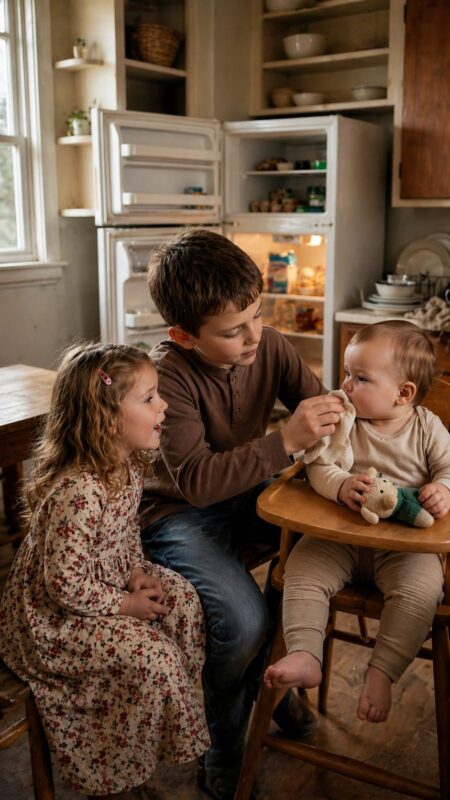
He was nine years old, standing barefoot in the dim kitchen, reaching for a jar of peanut butter on the highest shelf.
The refrigerator hummed softly behind him, almost empty as always. Lily sat nearby swinging her legs, quietly watching. Baby Noah fussed in his chair, clutching a worn toy.
“Almost got it,” Ethan murmured.
Something about the house felt off—unnaturally still. No footsteps. No voice from down the hall. No familiar noise of their mother moving through the rooms.
He finally pulled the jar down and set it on the counter. Then he stopped.
“Stay here,” he told Lily. She nodded without question.
Ethan walked down the hallway and pushed open their mother’s bedroom door. Empty. The bed was unmade. Drawers open. A suitcase gone.
“Mom?” he called. Silence answered him. He checked every room, even the porch. Nothing. No sign she had ever planned to return.
When he came back, Lily was still in the same place. “Where’s Mommy?” she asked softly. Ethan swallowed hard.
“I think she had to go somewhere,” he said carefully. “I’m here.” “When is she coming back?”
He hesitated for a moment, then forced a small, unconvincing smile. “Sometime soon.”
Even as he said it, he already understood it wasn’t true. The following weeks changed everything.
Ethan learned how to stretch food, how to shop with almost nothing, how to keep two younger children alive when no one else stepped in.
He braided Lily’s hair every morning, changed Noah’s diapers, cooked what little they had, and quietly stopped expecting help.
School faded into the background. Some days, he simply didn’t go. He told no one.
If anyone found out, they might take Lily and Noah away—and that was the only thing he couldn’t allow.
Months turned into a year. They survived, but only just.
Ethan became quieter, more guarded. Lily rarely left his side. Noah, still too small to understand, began calling him “Dad” before he ever learned another name.
On a rainy afternoon when Ethan was ten, he stood outside a small grocery store, counting coins with shaking hands.
He was trying to decide whether he could afford bread or milk. Noah sat in a stroller beside him. Lily held onto his sleeve.
“You’re short,” a voice said gently. Ethan looked up. A woman stood there holding an umbrella. Mid-thirties. Tired eyes, but soft expression.
“I’m fine,” Ethan said quickly. She didn’t push. She just looked at the coins, then at the children. “My name is Sarah. I live nearby.”
He stayed silent. “I’ve seen you around,” she added. “You’re taking care of them.” Still nothing from him. She crouched slightly to meet his eyes.
“You don’t have to do everything alone.” Something inside Ethan tightened.
“I’m not alone,” he said firmly. “I know,” she replied. “But you shouldn’t have to carry all of it.”
She didn’t insist. She didn’t demand anything. She simply stayed present. And she came back. Again and again.
Sometimes with groceries. Sometimes just to help with homework. Sometimes to hold Noah when he cried too long. Slowly, without pressure, something began to shift.
Years passed. What started as survival turned into stability. Sarah never forced herself into their lives—she simply remained until she belonged.
Lily called her “Mom” first. Noah followed without hesitation. Ethan resisted longer than both of them, but eventually, even he stopped correcting it.
She never asked for the title. They gave it to her. By the time they were grown, life had become something steady.
Ethan was independent and responsible, Lily was in college, and Noah was full of energy and laughter. Sarah remained the constant center of their home—not by obligation, but by choice.
Then, fourteen years after the night everything fell apart, a knock came at the door. Their biological mother had returned.
She said she was sorry. She said she wanted them back. She said she had made mistakes she couldn’t undo. The meeting was nothing like she imagined.
The children were older now—and honest about the damage left behind. There was no warmth waiting for her, only distance and truth.
Sarah stood with them, calm and steady, never raising her voice, never claiming ownership of their feelings—but making one thing clear: their lives would not be rewritten by the past.
In the end, there was no reunion. Only closure. She left the same way she had once disappeared—quietly, without taking anything back with her.
And when the door closed, the house didn’t feel broken anymore. It felt finished. Because family, for them, was never about who gave birth to you. It was about who stayed.