He was too poor to raise three daughters—fifteen years later, they returned in black SUVs and shattered the lie that had taken them away.
Rebecca agreed to arrive by 8:30, and Daniel rushed to get the spare room ready, completely unaware that his life was about to take a turn he could never undo.
That evening, she arrived with three girls—Claire, Maddie, and Sophie—each carrying their own kind of fear.
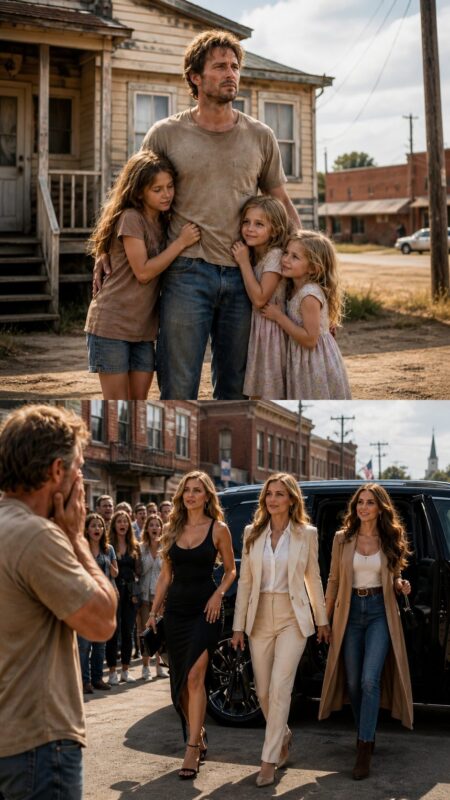
Daniel welcomed them quietly, offering warmth, safety, and simple food from a nearly empty kitchen.
The girls stayed guarded: Claire watched everything closely, Maddie spoke with sharp defensiveness, and Sophie clung silently to her sisters.
When Rebecca asked how long they could stay, Daniel only answered softly, “For tonight.”
After she left, he showed them the small bedroom and tried to ease their anxiety, assuring them the house was safe.
Before they fell asleep, he quietly repeated a promise that would become their nightly ritual: “You’re safe here.”
In the following days, Daniel struggled with things he had never had to think about—like how to care for three traumatized children on his own.
Even simple choices felt overwhelming, until a neighbor stepped in with advice, patience, and later, basic supplies. It was the first sign that he wouldn’t be completely alone in this.
By the second week, the town had divided itself—some people quietly helping, others watching and judging. Still, something began to shift.
The girls started to relax in small ways. Trust grew slowly, helped by tiny routines like carving wooden birds together at the kitchen table.
Somewhere in that fragile stability, Daniel made a decision: he would adopt them. Then came the storm.
Sophie panicked during the thunder and ran outside.
Daniel chased after her and managed to bring her back—but in doing so, he was seriously injured.
During his recovery, the girls cared for him in return, and something deeper formed between them: not obligation, but family.
Not long after, wealthy grandparents—the Sterlings—appeared, demanding custody.
They promised the girls comfort, education, and security. In court, despite Daniel’s love and effort, the ruling went in their favor.
The girls were taken away.
Daniel wrote to them for years, never stopping, never receiving answers.
What he didn’t know was that every letter had been hidden by their grandmother.
The girls grew up believing he had abandoned them completely.
When they finally uncovered the truth as adults—letters, forged messages, and years of deception—they returned to Ash Creek together.
They confronted everything that had been buried. And when the truth came out, the damage of the past finally began to break.
In the end, they found their way back to Daniel—not just as daughters reclaiming their father, but as a family rebuilding what was stolen from them.
Together, they created a foundation to help children in similar situations.
And what remained was a simple truth: real fatherhood isn’t measured by money or status, but by presence, sacrifice, and love that refuses to disappear.