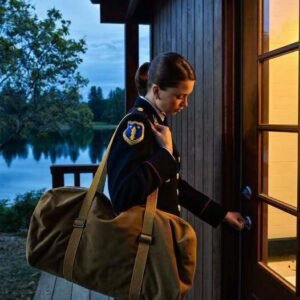
Seven years is a long time to weave your life around someone else’s presence. It is long enough for routines to feel permanent, for shared dreams to become plans, and for the future to seem agreed upon without needing to be spoken aloud. When her fiancé ended their engagement just three weeks before the wedding,
the shock hollowed everything familiar. His explanation lingered painfully in her mind. He spoke about wanting more, about feeling trapped by a life that felt too small and ordinary for him.
In the silence that followed, she wasn’t just grieving the end of a relationship. She was mourning the loss of a future she had carefully imagined, one built on trust, patience, and years of shared history that suddenly felt erased.
The months that followed were slow and heavy. She learned how to move through days that no longer had a shared direction, how to sit with questions that would never be answered. Friends encouraged anger, distance, and closure through forgetting, but grief does not move on command.
She focused on rebuilding herself quietly, one small step at a time, relearning who she was without the plans that had once anchored her. Six months later, news reached her that disrupted that fragile progress.
The man who had left so confidently in search of something greater had been seriously injured in a road accident. He could no longer walk, his independence stripped away, and many of the people who once filled his life had drifted elsewhere. His family lived far away, and he was facing recovery largely alone.
She hesitated for days before deciding to visit him. It was not nostalgia or hope that pulled her there, but something simpler and harder to explain.
Compassion felt heavier than resentment. When she arrived, she made her boundaries clear.
She was not there to rekindle what had ended or to rewrite the past. She was there so he would not endure recovery in complete isolation.
What followed was a season defined not by dramatic reconciliation, but by patience and quiet endurance. She helped with daily tasks, sat beside him during therapy appointments, and stayed through long evenings filled with uncertainty.
There were no grand apologies, no attempts to undo old choices. Instead, there were shared meals, long silences, and moments where regret surfaced in his eyes without ever needing words.
Nearly a year later, his health declined due to ongoing complications, and he passed away peacefully. At the memorial service, surrounded by familiar faces and distant acquaintances, she felt the weight of an ending that was complicated but calm.
As she prepared to leave, a woman approached her and quietly handed her a small envelope. Inside was a brief note, written shakily but deliberately. It did not ask for forgiveness.
It simply expressed gratitude for her presence when everything else had fallen away.
He wrote that losing what he once thought mattered had finally taught him the value of the life he had dismissed. Walking away, she understood something that brought her unexpected peace.
Kindness does not always return as love, reunion, or second chances. Sometimes it returns as quiet closure, and in choosing empathy when it mattered most, she had given herself exactly that.