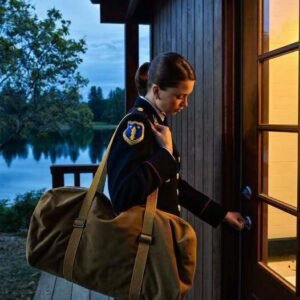
When Sergeant Ryan Maddox stepped out of the carpool onto the curb, he expected the porch light to be the same warm yellow he remembered: steady, welcoming, safe. Nine months abroad had trained him to observe every shadow, but tonight he wanted to stop observing. He wanted to be home. He wanted his little sister.
The house seemed smaller than he remembered, but the scent of damp cedar and the crooked bell by the door were unchanged. Ryan climbed the stairs with his backpack, his heart pounding like no patrol car had ever seen him. He hadn’t sent a text beforehand. He wanted the surprise: the shout, the hug, the laughter, the relief.
He entered with the old key hidden under the loose brick. The entrance was dimly lit. A television was playing softly somewhere, its volume low. Ryan quietly placed his backpack against the wall and called out, “Mara?”
There was no answer. He followed the sound of the television into the living room.
Mara stood near the sofa in an oversized hoodie, her hair pulled back in a messy bun. For a second, her face lit up, and Ryan saw the girl who used to run with him to the mailbox and beg him to draw cartoons with her. Then his expression changed, like a door slamming. His eyes scanned her uniform, then her boots, then the hallway, and he took a step back.
“Mara?” Ryan asked again, more gently.
She smiled, but the smile didn’t reach her eyes. “Ryan… are you home?”
He moved closer, ready to embrace her. She flinched, just a slight tug, but unmistakable. The sleeve of her sweatshirt rode up, and Ryan’s chest tightened. A bruise appeared along her forearm, dark and oval, as if someone had grabbed her too hard. Another faint mark crept up toward her wrist.
Ryan forced himself to maintain a neutral expression, as he’d been taught. Inside, something fiery and fierce rose. “What happened to your arm?”
Mara quickly pulled down her sleeve. “Nothing. I bumped into the door.”
Ryan looked up. A yellowish shadow lingered on his cheekbone beneath the makeup, a shadow that didn’t suit him. His lips were dry and chapped at the corners. She wouldn’t meet his gaze for more than a second.
“You don’t have to lie,” Ryan said quietly. He’d learned abroad that the wrong tone could turn a tense moment into a disaster. But this was his sister. This was the home he’d sworn to protect.
Mara swallowed hard and tried to laugh. “I’m fine. It’s silly. Don’t start.”
From the hallway, a floorboard creaked. Mara froze. Her hand went to her phone on the coffee table as if she needed it, or as if she wanted to hide it. Ryan turned his head slightly, listening. Another creak. A male voice, muffled, then closer.
Mara’s whisper came out strained: “Ryan… you weren’t supposed to be here.”
Ryan’s pulse quickened. “Who’s here, Mara?” His eyes widened in panic as a man’s silhouette filled the hallway entrance and he asked irritably, “Who are you talking to?”
Part 2
The man stepped into the living room like he belonged there. Late twenties, thick forearms, a baseball cap pulled low. He looked Ryan up and down, pausing on the uniform. His jaw tightened in irritation disguised as confidence.
Ryan didn’t move. “I’m Ryan. Her brother.”
The man’s eyes flicked to Mara, and something changed in his expression—an unspoken warning. “I’m Derek,” he said, hand half-lifting as if a handshake might establish control. “You must be the soldier.”
Mara’s shoulders curled inward. Ryan caught how she angled herself slightly behind the couch, like it could shield her. That alone told him more than any bruise.
Ryan kept his voice even. “Didn’t know she had company.”
Derek snapped. “I’m here a lot. We’ve been together for a while.” His tone implies Ryan was the outsider.
Ryan looked at Mara. “Can we talk?”
Mara’s eyes darted toward Derek again. “It’s fine,” she said quickly. Too quickly.
Ryan nodded once, as if he accepted it, then said to Derek, “I just got back. We’re going to catch up. You can head out.”
Derek’s smile sharpened. “That’s not your call.”
Ryan’s training screams at him: don’t escalate, control the scene, keep your hands visible. But another voice—the one built from childhood promises at their parents’ graves—roared louder.
He didn’t raise his volume. He didn’t threaten. He just stood, squared his shoulders, and took one step closer so Derek had to look up. “It is my call in this house.”
For a beat, Derek looked like he might argue. Then he exhaled through his nose and scoffed. “Whatever. I’ll see you later, Mara.” He said her name like a claim.
Mara nodded without speaking.
Ryan watched Derek leave, listening for the car door, the engine fading. Only then did he sit on the edge of the couch, leaving space between them. “You’re not in trouble,” he said. “You’re not disappointing me. I just need the truth.”
Mara’s hands twisted together until her knuckles blanched. “It’s complicated.”
“I’ve been gone nine months,” Ryan said quietly. “And I came home to you flinching at my hug.”
That cracked something in her. Tears rose fast, angry and ashamed. She wiped them away hard. “I didn’t want to drag you into it while you were… there.”
Ryan held his breath, steady, like a medic waiting for the patient to speak. “Tell me what ‘it’ is.”
Mara stared at the carpet. “He gets jealous. Of everything. If I don’t answer quickly, he blows up. If I wear something he doesn’t like, he says I’m disrespecting him.” Her voice shrank. “He checks my phone. He says my friends are bad for me. He—” She stopped, throat tight. “He grabs me when I try to leave.”
Ryan’s hands curled into fists on his knees. He loosened them deliberately. “Has he hit you?”
Silence. Then Mara nodded once, barely.
Ryan swallowed the burn behind his eyes. “Mara, you didn’t cause this.”
“I did,” she whispered. “I always made it worse. If I just stayed calm—if I didn’t talk back—”
“No,” Ryan said, firmer now, but still controlled. “That’s what he wants you to believe. It’s not true.”
Over the next days, Ryan didn’t play hero. He made breakfast. He fixed the broken porch step. He asked Mara what she wanted, not what he wanted to do. He set small, steady routines that made the house feel predictable again—music while cooking, short walks in the afternoon, a movie night with the lights on.
At night, he heard Mara crying behind her bedroom door, muffled into a pillow like she was trying not to exist. Every sound pulls him back toward the edge of anger. Still, he stayed patient. He knew fear could make someone defend the person hurting them. He knew shame could make a victim protect the abuser.
On the fourth day, Ryan came back from the grocery store early because he’d forgotten his wallet. The front door was unlocked. He stepped inside and heard Derek’s voice—low, sharp—and Mara’s, shaky.
“I said give me your phone,” Derek snapped.
Ryan rounded the corner and saw Derek’s hand clamped around Mara’s wrist. Mara’s face was pale, eyes wide, trying to pull away without triggering him. The sight hit Ryan like an explosion he couldn’t duck.
Ryan planted himself between them, voice calm as ice. “Let go. Now.”
Derek’s grip tightened for half a second, then he noticed Ryan’s eyes—steady, unblinking, trained. He released Mara and threw his hands up. “She’s being dramatic.”
Ryan didn’t move. “Get out.”
Derek’s mouth opened, but Ryan took one step forward, and the argument died in Derek’s throat. He backed toward the door, muttering threats about “regret” and “don’t call me again,” then left.
Mara slid down the wall, shaking. Ryan knelt beside her. “We’re going to do this the right way,” he said. “Police, a protection order, a safety plan—whatever you choose. But you’re not alone.”
Mara looked at him, tears spilling freely now. “Will he come back?”
Ryan didn’t lie. “He might try. But we’re going to be ready.”
Part 3
The next morning, Ryan made a list on a yellow notepad and slid it across the kitchen table like a mission report: clear, simple, doable. Mara looked at it as if it belonged to someone else.
Change passwords.
Tell two trusted friends.
Document the injuries.
Call a local domestic violence helpline to get a safety plan.
Consider a restraining order.
Decide what to do with Derek’s spare key.
Mara ran a finger along the edge of the paper. “I feel stupid,” she said.
Ryan set down two cups of coffee and sat down across from her. “You’re not stupid. You adapted to survive. That’s not weakness.”
She inhaled, her voice trembling. “He told me no one else would put up with me.”
Ryan leaned forward, his voice firm. “That’s a lie abusers use to make you feel trapped. You have people. You have me.”
He didn’t call the police without her. He didn’t post anything on social media. He didn’t turn his grief into a family publicity stunt. He let Mara take the lead, because taking control away from her, even for good reasons, could feel like being caged again. Instead, he offered her options and backed them up with actions.
That afternoon, they called a local hotline together. The advocate’s calm voice guided Mara through a safety plan: have her bag packed, identify a neighbor she could turn to, park her car facing the street, and keep copies of important documents with a friend. Mara wrote everything down, her shoulders relaxing a little with each concrete step. Fear hates plans.
Ryan helped her photograph the bruises with time stamps, not because he wanted revenge, but because he wanted protection with evidence. They changed the locks. Ryan installed a camera on the doorbell and then made sure Mara felt comfortable. “It’s your house,” he reminded her. “Not mine.”
Two days later, Mara agreed to report the incident Ryan had witnessed. Sitting in the police station lobby, she looked like she was about to run away. Ryan didn’t grab her arm. He didn’t say, “Be brave.” He simply sat beside her and breathed slowly until she matched his pace. When the officer asked her questions, Mara’s voice trembled, then grew stronger. She told the truth as if pulling it from a deep place, buried under shame.
Later, in the parking lot, Mara exhaled so sharply it sounded as if the sorrow were leaving her lungs. “I thought I would feel… happy.”
“You can feel a hundred things,” Ryan said. “Relief and anger can coexist in the same body.”
The first real change came quietly. Mara went back to sleeping with her bedroom door open. She laughed once, just once, at a silly joke Ryan made while he was burning pancakes. The sound startled them both. Then she covered her mouth and laughed again, as if she had found a part of herself hidden behind a closed door.
Mara returned to her sketchbook. At first, she only drew hands: open hands, hands with paintbrushes, hands outstretched toward the sunlight. Ryan didn’t comment much. He simply noticed. He put the pencils down on the table without giving it much thought. He learned that healing didn’t need words; it needed firmness.
In less than a month, Mara joined a support group. It was the first time she’d ever felt that knot in her stomach, and she went home calmer, saying, “I wasn’t the only one.” That sentence had power. Isolation had been Derek’s weapon of choice. Community broke him.
Mara began reconnecting with friends she had stopped responding to. She apologized for disappearing; they apologized for not pushing harder. They met for coffee. They strolled through a weekend art market. Mara’s posture changed—less hunched, more upright—as if her bones were remembering they had a right to occupy space.
Ryan returned to his unit’s schedule, which had boundaries he’d never had before. He visited her more often. He communicated with her without overwhelming her. He told Mara, “You don’t owe me news, but you can always ask for help.” What mattered was that she chose to trust him rather than being forced to.
One night, Mara brought two canvases into the living room and placed them on easels she had found online. “I’m thinking of teaching classes,” she said, her eyes sparkling with nervousness. “Art classes for children at the community center.”
Ryan smiled. “That sounds familiar.”
Mara nodded slowly. “I want to take something good from what happened. Not erase it. Just… not let it control me.”
Ryan felt something open in his chest. It wasn’t a victory, but something gentler. A return.
Because the truth was, the war didn’t end when she returned home. It simply changed form. And this time, the fight wasn’t about defeating someone. It was about helping Mara reclaim her life—a common and courageous decision.
If you’ve ever supported someone, or needed someone to support you, share your story below, like this post, and share it today.